

Phoenix 15 – From a Family Dinghy to Two Finished Boats
Every boat design has a story behind it. Some are considerably longer than others.
Over the last couple of years, we’ve had the pleasure of building two Phoenix 15s here at Duck Flat Wooden Boats, taking both from sheets of marine plywood and lengths of timber right through to complete, rigged boats ready to sail.
For us, though, these two boats represent a little more than another pair of completed builds.
The story of the Phoenix goes back more than 50 years.
The Original Phoenix
The lineage began with a 15-foot cruising dinghy designed and built by Victor Ross Lillistone, father of Australian boat designer Ross Lillistone.
Ross inherited the boat in 1974 and used her extensively for the sort of simple dinghy cruising that has remained a lifelong passion – exploring coastlines, beaches and shallow waters with little more than a capable small boat and somewhere to pull ashore at the end of the day.
That original boat was named Phoenix.
Remarkably, she is still sailing today and has now been used by four generations of the Lillistone family.
Years of sailing boats like Phoenix helped Ross settle on what he considered close to the ideal proportions for a beach-cruising dinghy: around 15 feet long, relatively narrow, light enough to row efficiently and move around ashore, but with enough capacity for a couple of people and their gear.
Those ideas eventually became Phoenix III, drawn in 2005.
Phoenix III went on to become one of Ross’s successful designs, with hundreds of sets of plans finding their way to amateur and professional builders around the world.
And that’s where Duck Flat eventually enters the story.
Phoenix III Becomes Phoenix 15
We’ve worked with Ross for a number of years, both supplying his plans and building boats to his designs.
One of the things we wanted to develop at Duck Flat was a comprehensive range of boat kits that made traditional wooden boatbuilding more accessible to people who may have always wanted to build a boat, but found some of the traditional processes a little daunting.
Phoenix III was an obvious candidate.
The original design uses glued-lapstrake – or glued-clinker – construction. It’s a fantastic method of building a lightweight and remarkably stiff hull, but traditionally requires a builder to set up molds and individually determine the shape of the planks through a process known as spiling.
None of this is beyond the amateur builder, but modern CNC cutting offered us an opportunity to remove much of that work.
Working together, Ross revised the design to take advantage of CNC-cut components while retaining the characteristics that made Phoenix III such a successful boat.
The result was the Phoenix 15.
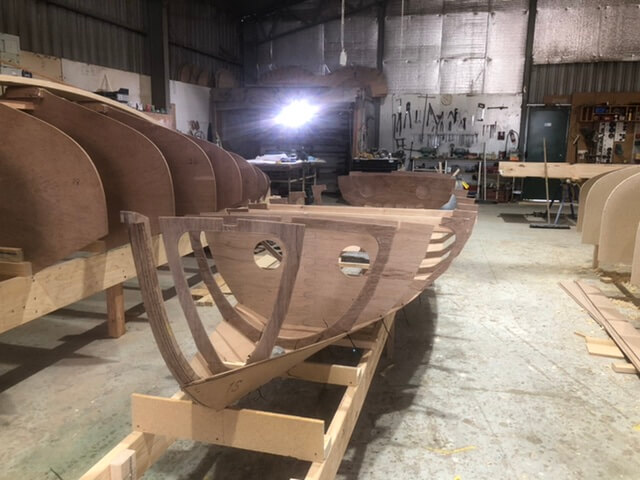
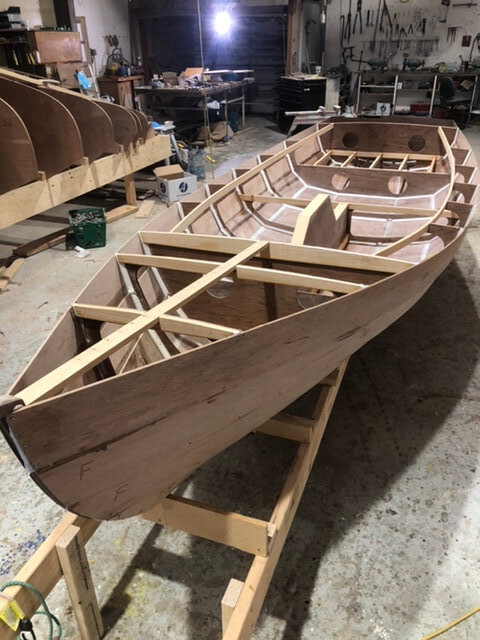
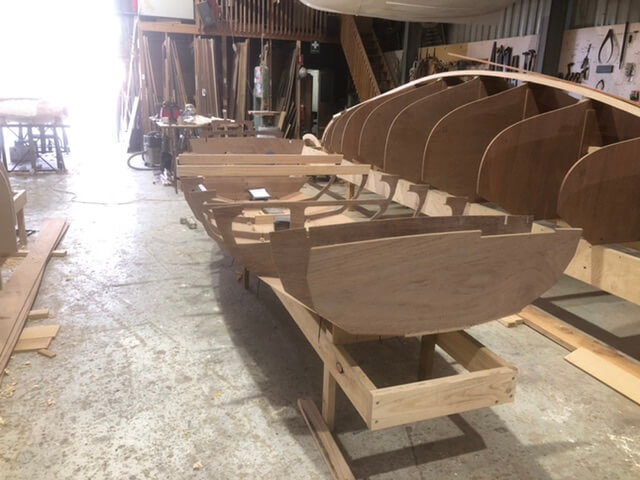
One of the most significant changes was replacing the traditional keelson and two lower garboard planks with a narrow 12mm marine plywood bottom panel. This eliminates some of the more difficult fitting and bevelling work while providing a strong foundation for the centreboard case, frames and bulkheads.
The lapstrake planks themselves can then be accurately CNC cut, along with the bulkheads, frames, transom, seats, decks and other major components.
The objective wasn’t to redesign Phoenix III.
It was to make a proven design easier and more approachable to build.
And Then We Built Two…
Developing a kit on a computer is one thing.
Seeing the finished boats sitting in the workshop, rigged and ready for the water, is considerably more satisfying.
These two Phoenix 15s were built completely in-house at Duck Flat and supplied as finished, ready-to-sail boats.
The hulls are built predominantly from marine plywood and epoxy, combining the stiffness and light weight of glued-lapstrake construction with the durability of modern epoxy systems.
From there, we were able to indulge in the part of wooden boatbuilding we particularly enjoy.
While the interiors and hulls are painted for practicality, we’ve retained plenty of bright-finished timber throughout the boats. Varnished gunwales, thwarts, centreboard-case trim and spars provide the contrast, while smaller details such as timber cleats and leatherwork around the mast give the boats some individual character.
Both carry the wonderfully simple balanced lug rig.
There are no complicated systems here. A timber mast, yard and boom, a single sail and a relatively small collection of ropes.
Rig it.
Launch it.
Go sailing.
A Sad Footnote to Pickle’s Story
Sadly, one of these boats has a story we never expected to be writing.
One of the two Phoenix 15s was named Pickle. Tragically, her owner passed away not long after taking ownership of the completed boat.
As far as we are aware, Pickle never had the opportunity to properly take to the water under her new ownership.
It’s particularly sad given the very reason these boats exist – to be simple, accessible boats that encourage their owners to get out on the water and enjoy sailing.
We were very proud to build Pickle, and we’re equally sorry that her owner didn’t get the opportunity to enjoy the boat in the way that had been intended.
We hope that, in time, Pickle gets the chance to fulfil that purpose and go sailing.
Built to Be Used
That simplicity is really what the Phoenix has always been about.
At approximately 15 feet, the Phoenix 15 is large enough to carry useful loads and comfortably take a couple of people sailing, yet remains small and light enough to launch, retrieve, row and handle without turning an afternoon on the water into a major operation.
It draws very little water with the centreboard raised, opening up the shallows, beaches and tucked-away corners which larger boats simply can’t reach.
And despite its traditional appearance, there is nothing particularly old-fashioned about the construction.
Modern marine plywood, epoxy adhesives and CNC-cut components make for a strong, stiff and relatively lightweight boat while removing much of the maintenance traditionally associated with old wooden dinghies.
Perhaps most importantly, it remains a boat which can realistically be built at home.
Build as Much – or as Little – as You Like
The Phoenix 15 is available through Duck Flat Wooden Boats at virtually any stage of completion.
For someone wanting the full boatbuilding experience, we can supply the plans and materials.
From there we can supply CNC-cut components and complete kit packages, including the plywood, timber, epoxy and other materials required for the build.
For those who want to do the fit-out and finishing but would rather leave the hull construction to us, we can build a bare hull ready to take home.
And, as these two boats demonstrate, we can take care of the entire process and hand over a finished Phoenix 15, rigged and ready to sail.
It’s a fairly unusual progression when you think about it.
A cruising dinghy built by Victor Lillistone more than half a century ago influenced a boat sailed extensively by his son. That experience led Ross to draw Phoenix III, which in turn evolved through our collaboration into the Phoenix 15.
And now another generation of Phoenixes has left the Duck Flat workshop.
One has already had the chance to show what the design was made for. We sincerely hope that one day Pickle will too.
After all, the whole point was always to build a simple boat and go sailing.